TRIXI GRONAU Manufactory · Knowledge
Correspondence Cards and Envelopes from our Hamburg Atelier
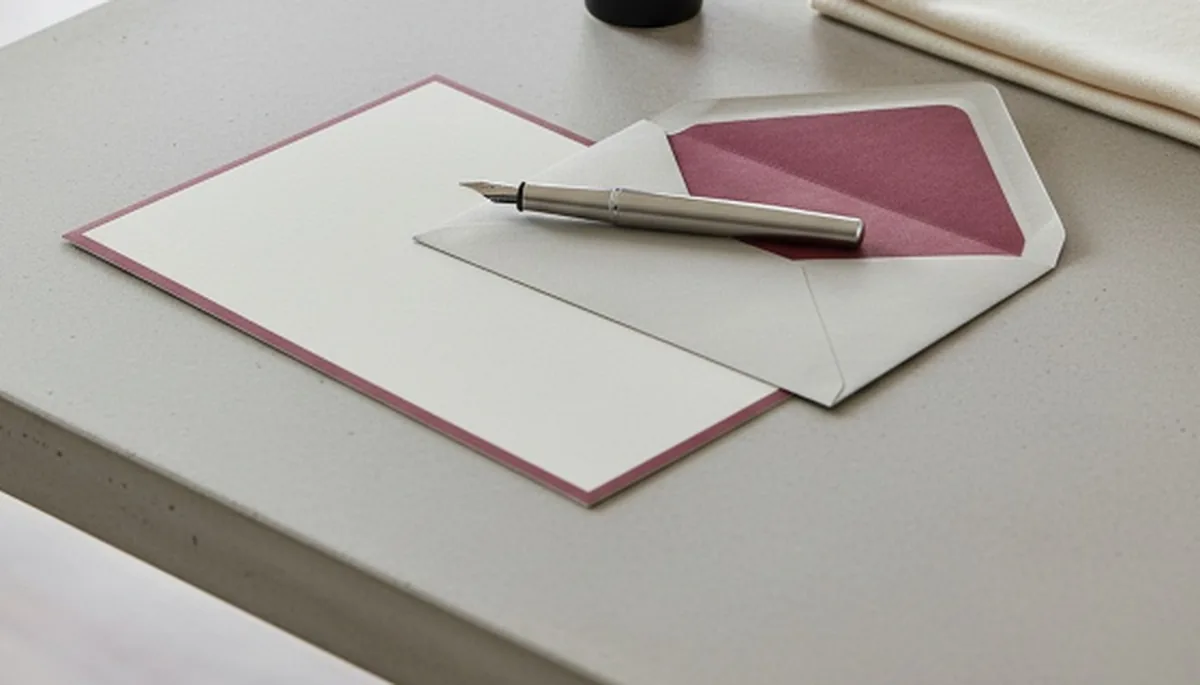
The correspondence card as a personal form of writing
For me a correspondence card is more than a piece of paper for a short message. Format, paper, printing, colour and envelope all belong together. There is no single right answer. What matters is always what the card is for, who receives it and what impression it should leave.
In our Hamburg atelier we make correspondence cards for private letters, invitations, personal notes, special occasions and individual commissions. They can be printed, embossed and personalised.
With small pieces like these, paper and printing show themselves very directly. You pick up the card, open the envelope, feel the surface and see every detail close up.
Which format suits a correspondence card?
My preferred format is B6. It offers enough room for a personal message and is at the same time large enough to hold a photograph inside the envelope.
A6 often feels too small to me. Photographs are usually larger today and a card should leave enough room so that additional enclosures do not look cramped.
DL at 105 x 210 mm strikes me as rather businesslike. For business correspondence this format can be exactly right, for a personal card I would usually choose a different proportion.
If a card should feel more generous, A5 is a good choice.
I also enjoy working with square formats. A card of 15 x 15 cm already has a very different presence than a classic DIN format. My favourite is 21 x 21 cm. Such a card catches the eye by its format alone, even before the envelope has been opened.
The format is therefore always part of the design, not just a technical measurement.
Card and envelope belong together
The envelope belongs to a correspondence card as much as the paper and the printing.
Ideally, card and envelope are matched in colour. If there is no envelope in the same tone as the card, I like to pick up the colour of the print instead. That still creates one closed picture.
A good example for me are the B6 cards from Crown Mill. I especially like the coloured edge of these cards. The matching envelopes take up the same tone and are lined with silk on the inside.
Such details change how a correspondence card is perceived. Before the actual message is even read, opening the envelope already gives an impression of material, colour and care.
What makes a good correspondence card?
There is no universal answer to this.
An invitation has different requirements than a personal thank-you card. A card that will be written on with a fountain pen needs a different paper than a card whose effect comes mainly from an embossing.
Paper weight, surface, format, colour and printing process therefore have to be considered together.
Sometimes a smooth paper is right, sometimes a textured one. Some designs call for colour, others come alive precisely through a quiet blind embossing. How much will be written by hand also shapes the paper choice.
More on these properties is explained in our Paper Knowledge.
Printing, embossing and personalising
Depending on the design, correspondence cards from our atelier can be produced with different techniques.
These include letterpress, hot foil stamping and blind embossing, along with further printing and finishing techniques we also cover in our glossary.
Which technique is used is not decided by a fixed rule. It has to fit the commission, the paper and the design.
I particularly enjoy commissions where clients give me creative freedom. Then I can think through which paper, which format, which colour and which printing technique will carry the idea best.
That is exactly the work that makes our manufactory meaningful to me.
The small, special commissions
I grew up in a print shop and bookbindery.
My father printed among other things the MieterJournal, the HSV Journal and catalogues for travel agencies. Those were larger print productions that belonged to the everyday craft of a printing house.
For me personally, however, the smaller, special commissions have always been the more interesting ones.
I love fine papers, particular printing techniques and work where material and design can be deliberately tuned to each other. A correspondence card, an invitation or a small personal print often offers especially beautiful possibilities for exactly that.
Precisely because the object is small, the details can become all the more important.
A correspondence card starts with its purpose
Our starting point is therefore not a specific format or a specific printing technique.
It is what the card should express.
From there we develop paper, format, envelope, colour and finishing.
Sometimes the result is quiet and restrained. Sometimes a card is allowed to stand out clearly through its format, colour or embossing. What matters is that all elements fit together and the card does justice to its occasion.
Frequently asked questions
Which format suits a personal correspondence card?
It depends on the occasion and the content. In the TRIXI GRONAU atelier I particularly like to work with B6. The format offers enough space to write and also lets you place, for example, a photograph inside the envelope.
Why is A6 not always suitable?
A6 can work well for short messages. If, however, a larger photograph or another enclosure should go into the envelope, I often find the format too small.
Does DL feel more private or businesslike?
DL at 105 x 210 mm feels rather businesslike to me. For personal correspondence I often prefer B6, A5 or square formats.
Do card and envelope have to be the same colour?
No. If there is no matching envelope in the card colour, the colour of the print can be picked up in the envelope, for example. What matters is that card, print and envelope work as one impression.
Which printing techniques suit correspondence cards?
It depends on paper, design and occasion. Possibilities include letterpress, hot foil stamping and blind embossing. The printing technique should not be chosen in isolation but has to fit the whole design.
Can correspondence cards be individually designed and personalised?
Yes. In the TRIXI GRONAU atelier correspondence cards are individually designed, printed, embossed and personalised. I especially enjoy developing solutions where paper, format, colour and printing technique are considered together from the start.
Related products in our shop
- Crown Mill Card Set Bi Color Grey Bordeaux A6: Card set with matching envelopes lined in burgundy silk.
- Crown Mill Small Card Set Bi Color Cream Dark Green A7: 25 cards in A7 with 25 matching unlined envelopes in C7.
- TRIXI GRONAU ELISA Mini Envelope Galluchat Black: Mini envelope from our own studio, larger quantities on request.
Related categories: GREETING CARDS and ENVELOPES.
Related studio services: Letterpress and Embossing on leather and paper.