TRIXI GRONAU Manufactory · Knowledge
Embossing dies from our Hamburg atelier
What is an embossing die?
An embossing die is the tool used to transfer a motif, logo, lettering or another design element onto a material, or to impress it into the material. At the TRIXI GRONAU atelier, dies are used primarily for hot foil stamping and blind embossing on embossing presses.
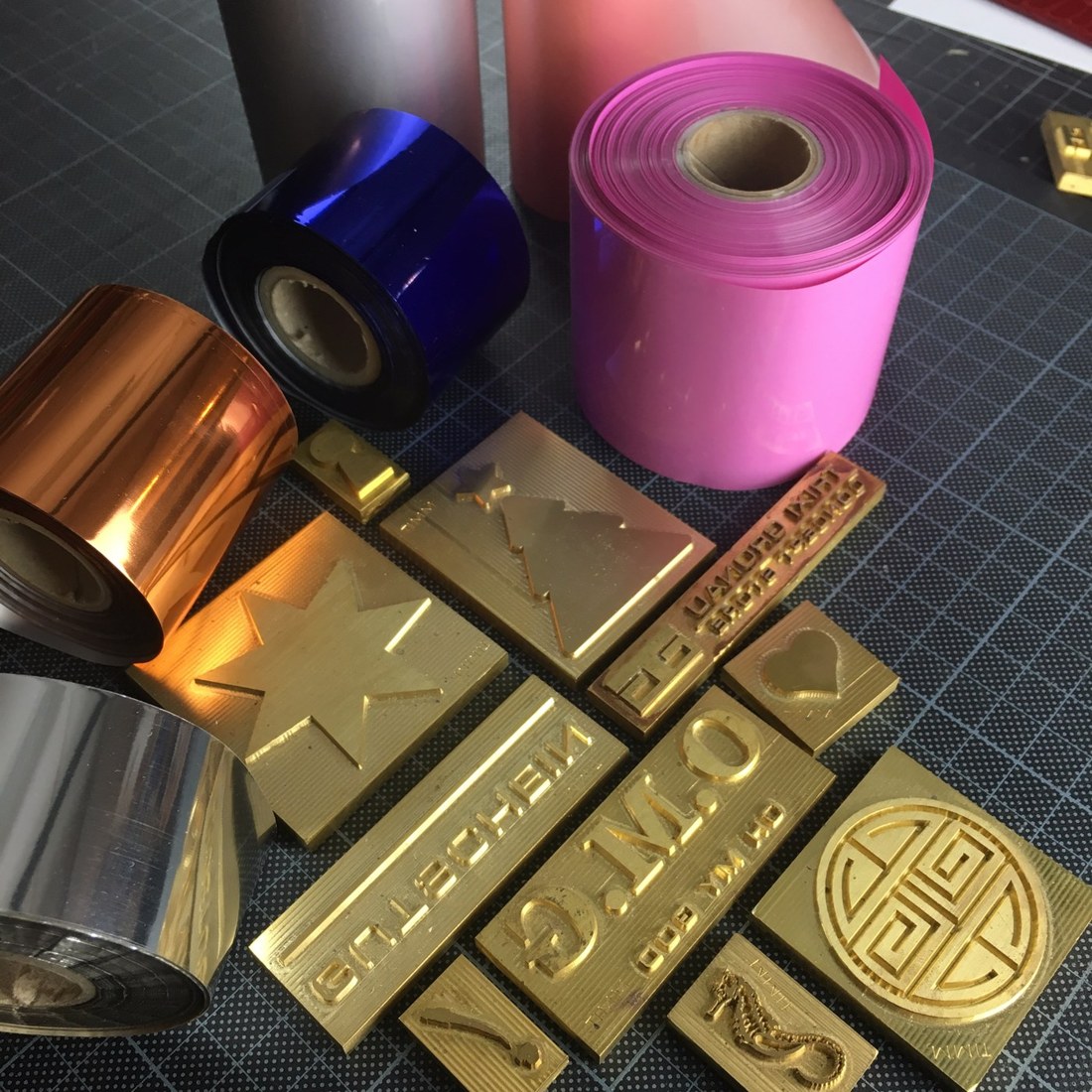
The die carries the motif in reverse. During embossing it meets the material under pressure. With hot foil stamping, a stamping foil is transferred at the same time. With blind embossing, the motif remains without visible colour or foil and is created by shaping the surface itself.
Which dies do we use in the atelier?
For individual motifs, TRIXI GRONAU works predominantly with brass dies. Magnesium dies are also used. The choice depends on the motif, the material, the intended job and the type of embossing.
For larger or recurring commissions, a dedicated die is made for the individual motif. This can be a logo, signet, graphic motif or lettering. For personalisation with names or initials, Corinna also works with individual embossing characters.
Brass dies in the atelier
Brass dies play an important role in the workshop. Many motifs that are used repeatedly over the years exist as brass tools. They can be used for our own designs, customer work and recurring motifs.
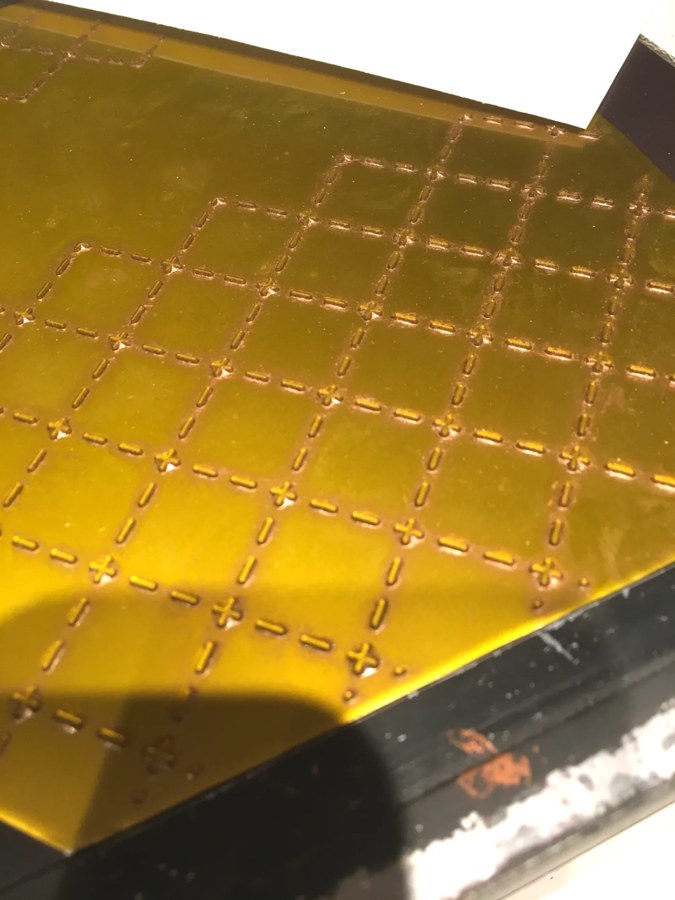
For Corinna, working with a new die begins with the design. The motif starts as an idea. The tool is then made. The special moment is the first impression: only then does it become clear on the actual material whether the motif has the effect that was intended in the design.
Magnesium dies
Alongside brass, TRIXI GRONAU also uses magnesium dies. They are likewise tools used for hot foil stamping and can be made for individual motifs.
Embossing characters for names and initials
Not every personalisation requires a dedicated die. Individual embossing characters can be used for names, initials or short texts. The atelier has different typefaces and character sets for this purpose.
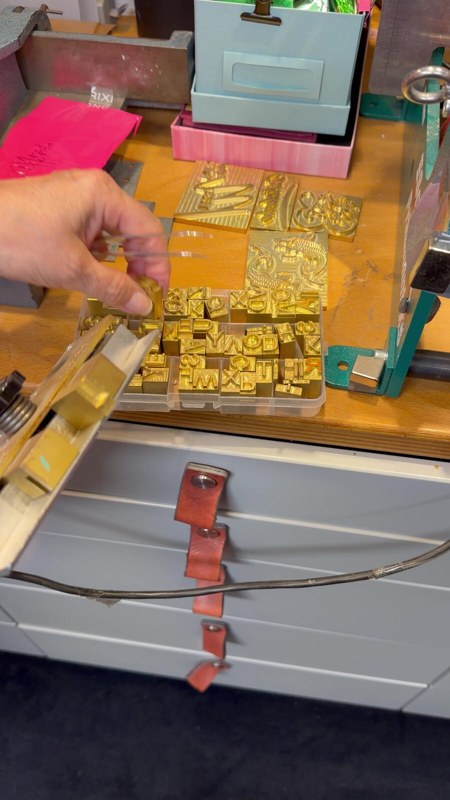
Some of the existing type is made of lead. Individual embossing characters are also used for personalisation and can be made of different metals depending on the set and application.
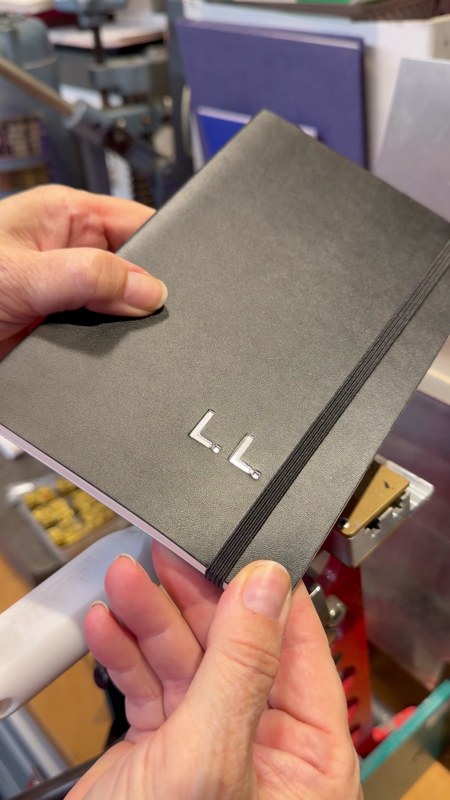
The advantage of individual characters is flexibility. Names and initials can be composed anew each time without producing a separate motif die for every person.
When is a dedicated die needed?
A dedicated die is useful when a specific motif needs to be reproduced exactly as it was designed. This applies, for example, to logos, signets, illustrations, graphic elements or individual lettering.
For customer commissions, the process often consists of design, approval, tool production, proof impression and then the actual job. Only with the finished die can the effect on the intended material be assessed reliably.
Why is a proof impression important for the die as well?
A good die alone does not guarantee a good result. Motif, tool, foil, temperature, pressure, dwell time and material all have to work together.
Before the final work, Corinna therefore checks how the die behaves on the actual material. A proof is particularly important with fine lines, small type, textured surfaces or new materials.
What makes a motif suitable for an embossing die?
Not every motif behaves the same way during embossing. Very fine lines, small counters or heavily structured areas can be more demanding than clear, compact shapes.
For Corinna, it is important that the motif remains clearly recognisable on the finished product. A good embossed result is not created by using as much pressure as possible, but by matching motif, tool and material correctly.
A die and a matrix are not always the same thing
For blind embossing on Schmedt or Baier presses, a single die can press directly into the material. For a sculpted blind embossing on a Heidelberg platen, TRIXI GRONAU works with a matched male and female tool, in other words matrix and counter-die. Both belong to embossing, but the technical setup is different.
Embossing dies in hot foil stamping
In hot foil stamping, the die is heated. Under heat and pressure it transfers the intended layer of stamping foil onto the material. The die determines exactly where the foil is transferred.
The quality of the finished result therefore depends on the tool as well as on the correct foil and the material. A finely made motif can look very different on two different surfaces.
Embossing dies at TRIXI GRONAU
Embossing dies have been part of the Gronau family's craft practice for decades. Today Corinna combines the traditional technique with individual designs, personalisation and both small and larger customer commissions.
The atelier uses them for embossing notebooks, photo albums, guest books, softcover books, leather goods, key rings, folders, boxes and stationery, among other things.
Questions about embossing dies
What is the difference between a die and individual embossing characters?
A die carries one fixed motif. Individual embossing characters can be recomposed again and again to create names, initials or short texts.
What materials are the dies at TRIXI GRONAU made from?
For individual motifs, the atelier predominantly uses brass. Magnesium dies are also used. The atelier also has lead type among its typefaces and character sets.
Does every logo need its own die?
If a logo or individual motif is to be embossed exactly, a dedicated tool is generally produced for it. Names and initials can often be composed from existing character sets instead.
Can the same die be used on different materials?
It may be possible, but the result has to be checked each time. Paper, card, leather and covering materials respond differently to pressure, heat and foil. This is why a proof impression is part of the workflow.
What happens with the first impression from a new die?
For Corinna, this is always a special moment. Only the first impression on the actual material shows whether motif, tool and material create exactly the effect that was intended during the design stage.
Related products in our shop
- Crown Mill Card Set Bi Color White Bamboo Green A6: According to the product text the cards can be embossed individually, for example with initials, a name or a motif.
- Crown Mill Card Set Bi Color White Pink A6: The same series in white and pink, also available with individual embossing.
- Crown Mill Small Card Set Bi Color Cream Dark Green A7: Personalised with our in-house embossing, for example a monogram, initials or your own motif.
Related categories: MAKE IT PERSONAL.
Related studio services: Embossing on leather and paper and Hot foil stamping.
More from the glossary