TRIXI GRONAU Manufactory · Knowledge
Machines & Tools in our Hamburg Studio
Why do machines and tools belong in a manufactory?
A great deal of the work in our manufactory is done by hand. Hand work does not mean, however, that we only ever reach for simple hand tools. Accurate embossing, cutting, pressing, drilling, eyeletting, binding and screen printing all call for machines that make certain steps possible or easier to carry out.
Some of our machines have been with the family since my parents ran the business. Others I bought later, because they make particular jobs simpler or more precise. A machine does not take the place of working by hand. It supports it.
What matters is still how a piece is set up, positioned and worked on. I make most of the settings myself, and even with a machine, experience and a feel for material, pressure and position remain essential.
Our embossing presses
For embossing we work with a Baier embossing press and a Schmedt embossing press, also known as the Schmedt Prägnant.
The Baier press comes from my parents' workshop and is still in use today. It has a foil feed, which is a real help when several identical or similar impressions follow one another.
On the Baier, the piece being embossed lies flat on the press bed below.
The Schmedt press came later. With this one, the piece sits directly in front of me while I work. With books in particular I find that position comfortable, because I can see the piece straight ahead of me and line it up.
Neither press makes the other redundant. Each earns its place on different kinds of work.
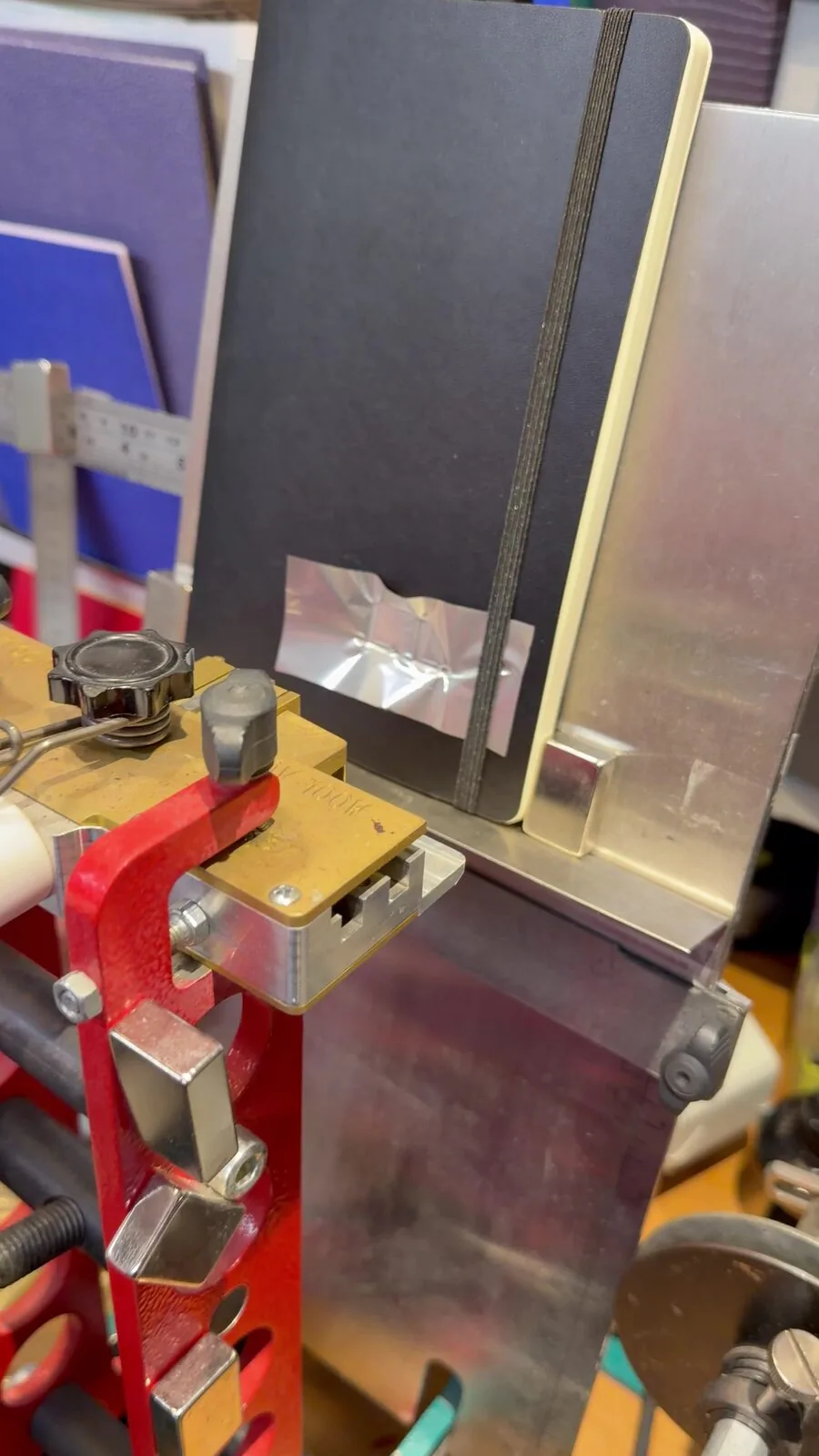
What has to be set on an embossing press?
Before an impression is made, I set the machine up myself.
This includes in particular:
- the exact position of the impression
- the pressure
- the temperature
For hot foil stamping, the foil, the material and the tool also have to suit one another.
In general technical terms, the contact or dwell time is mentioned as well, because it too can affect the result.
An impression is therefore not simply a matter of laying a piece into a press. Only careful setting up determines where the motif sits and how cleanly it transfers.
With a new material or a new motif, a proof impression is a matter of course for me.
The Opus machine for making book cases
For making book cases we use a machine by Opus.
The case itself is still built by hand. The machine supports me through several steps that call for precision.
Board and covering material can be positioned exactly. There is also a fitting that trims the corners of the covering material cleanly.
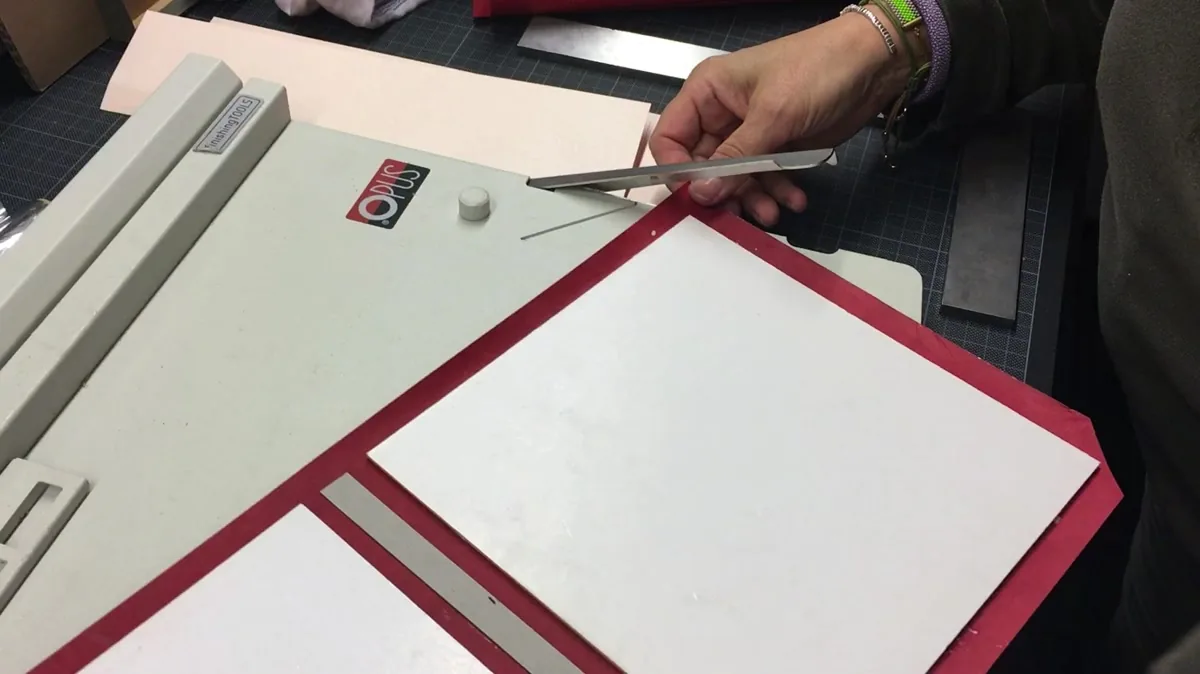
The fitting for turning in the covering material matters most. The overhanging edges of the covering are folded around the board and then pressed down.
In this way the machine supports the manual build of a book case without taking over the craft itself.
Presses in the bindery
Presses have always been among the classic pieces of equipment in a bindery.
We work with a standing press and an old screw press, among others.
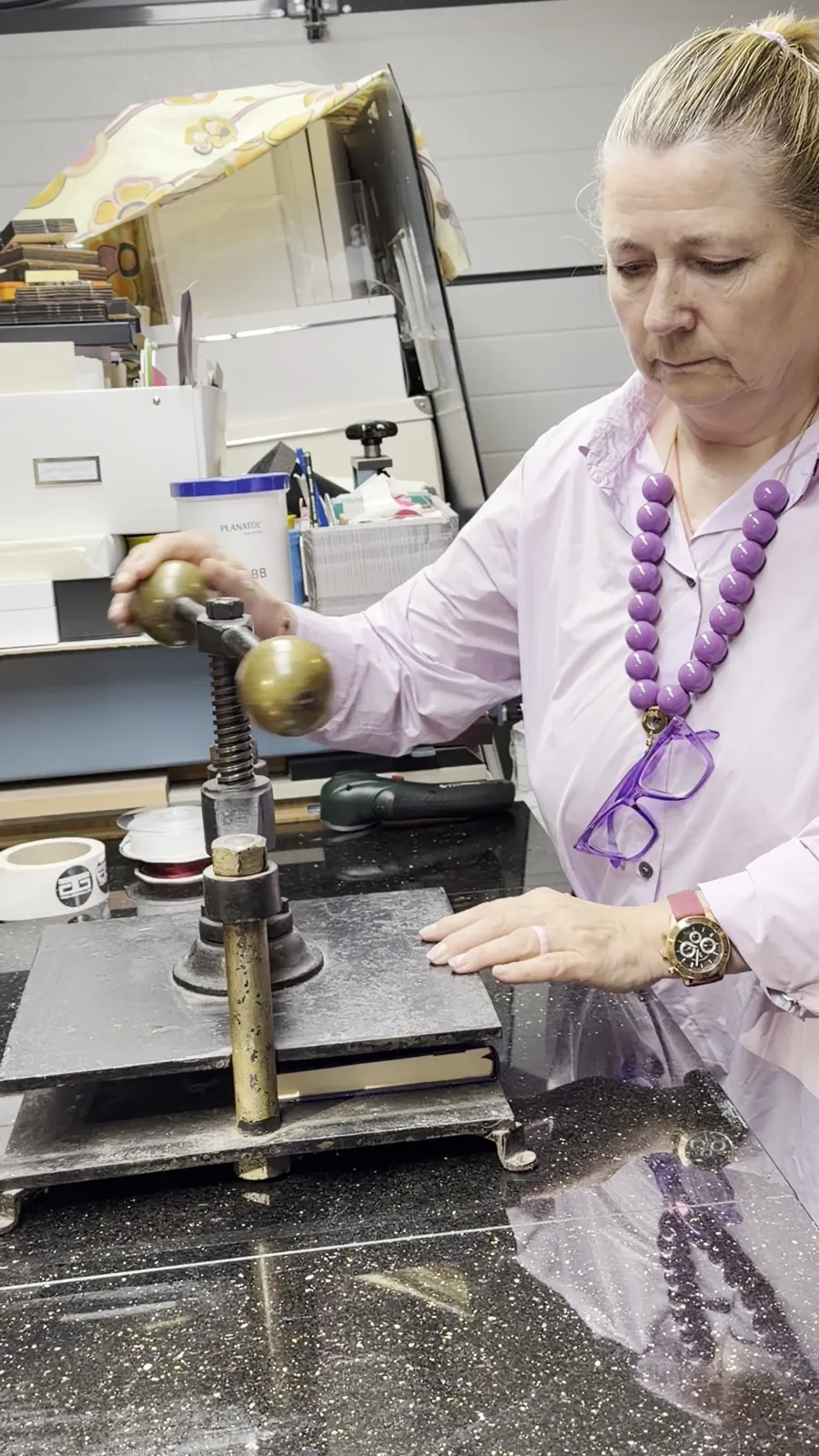
The screw press also comes from my parents' workshop. It is a heavy, classic binder's press and is used for pressing books.
The threaded spindle applies even pressure to whatever is laid in it.
Presses like these show particularly well that some tools and machines can stay in use across generations. Their technical task has not changed: a book or another bound piece should be pressed quietly, evenly and under control.
Cutting paper, card and board
For larger cutting jobs we use an electric Ideal stack cutter.
With it we cut:
- paper
- card
- binder's board
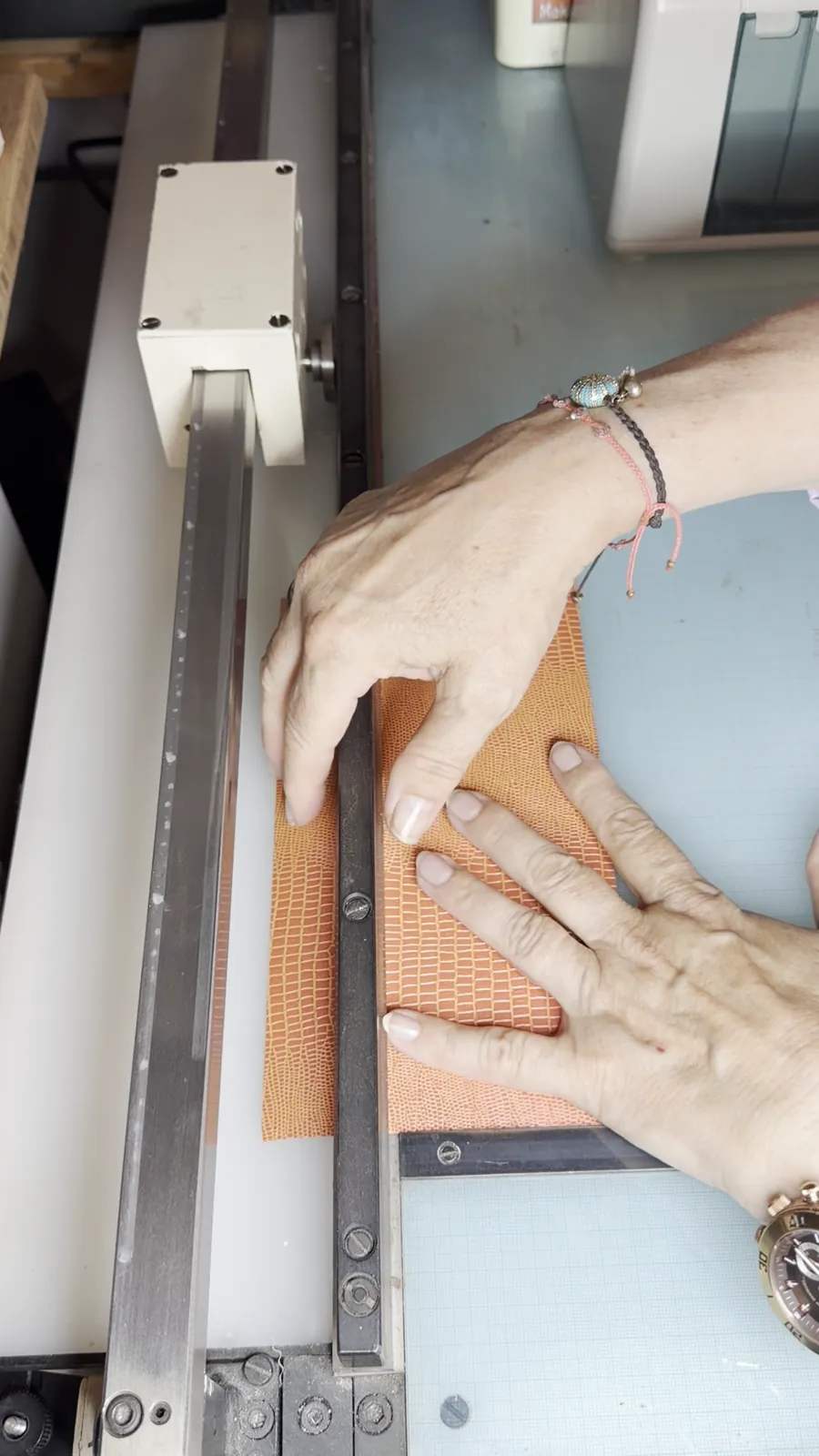
For single sheets and for small or especially exact work I also use a Bacher rotary trimmer.
This trimmer dates from my father's day. It was originally used for cutting film. Today I use it for single sheets and for jobs that call for a very precise small cut.
We also have a larger rotary trimmer. I use that one for covering fabrics that come off the roll, among other things.
Which cutting tool makes sense depends on the material, the format and the job in hand.
Paper drill
Our paper drill also comes from my parents' workshop.
I use it today for the inner pages of our Calla, Isa and Sabrina photo albums, and for gift tags.
A paper drill produces clean holes through paper and through several layers at once. Where positions repeat and several inserts are involved, it is far more accurate than punching by hand.
Corner rounder
Our corner rounder turns square corners into even, rounded ones.
We use it for pieces such as:
- cards
- book cases
- tags
This machine, too, comes from my parents' workshop.
A rounded corner changes more than the look. On certain products, rounded corners can also sit more pleasantly in the hand and are less prone to damage than very sharp corners of card.
Further machines from the bindery
Our bindery equipment also includes a leather paring machine.
Alongside it stands a swing arm press, generally also referred to as a cutting press. It is not needed for making a book itself. It comes into play on other work where materials or shapes have to be cut out. The material and the cutting die are positioned exactly in the press. The glossary page on die cutting covers this in more detail.
For scoring I now work with an electric scoring machine. Scoring and folding have a glossary page of their own, where the process is described in full.
The eyelet press
One of our older machines is the eyelet press.
My parents once used it for luggage tags they printed for a travel agency. The tags were fitted with eyelets after printing.
Today I use that same machine for our gift packaging.
The closure is fitted with an eyelet, and I then thread gift ribbon through it.
Over the years the machine has taken on a different job, and it remains part of our daily hand work.
Machines and tools in screen printing
Screen printing calls for equipment of its own.
Our working kit includes:
- screens
- squeegees
- spatulas
- a screen printing carousel
- screen printing inks
- prepared screens with stencils
- masking tape
- the material to be printed
- a drying rack trolley
- a flash dryer
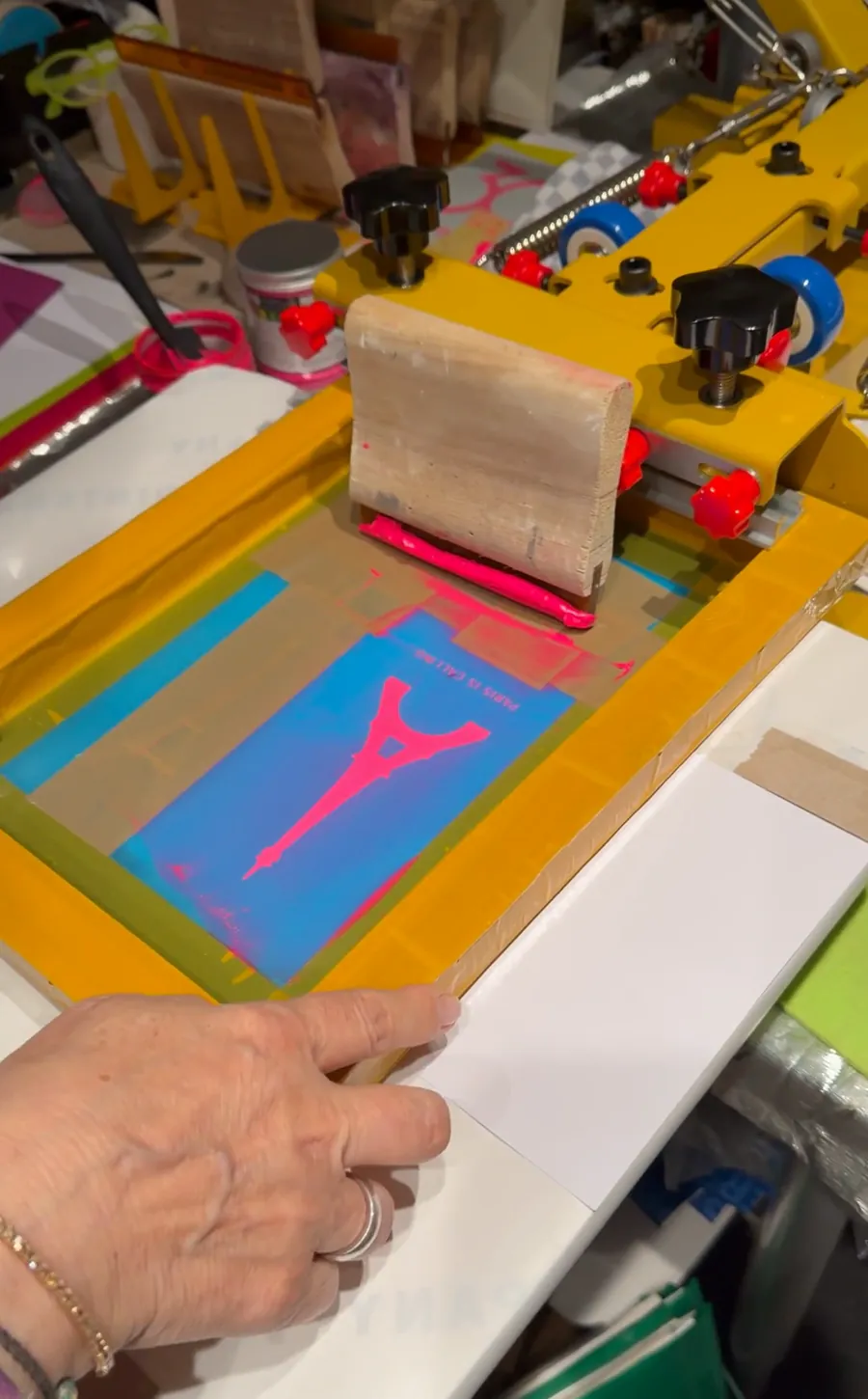
The squeegee draws the ink across the screen and presses it through the open areas of the stencil onto the material beneath.
A drying rack trolley gives freshly printed pieces room to dry separately from one another.
The flash dryer helps printed materials to dry, either between passes or at the end.
The screen printing carousel helps to position screens and pieces for the individual print runs.
In screen printing as well, the machine or the equipment is only one part of the process. Ink, screen, stencil, squeegee, material and the movement of the squeegee all have to work together.
Lead type, wood type and printing plates in letterpress
Our letterpress holdings consist mainly of lead type and printing plates, along with wood type.
A large part of this material still comes from my parents' time.
Individual pieces of type can be composed by hand into words and lines. Printing plates, by contrast, are used for fixed motifs, lettering or graphic elements.
The printing itself is done on a Boston platen press, a platen press for hand crafted letterpress work. The printing elements are set up in the press, the rollers spread the ink over the raised surfaces and the paper is pressed against the inked forme. The glossary page on letterpress covers this in more detail.
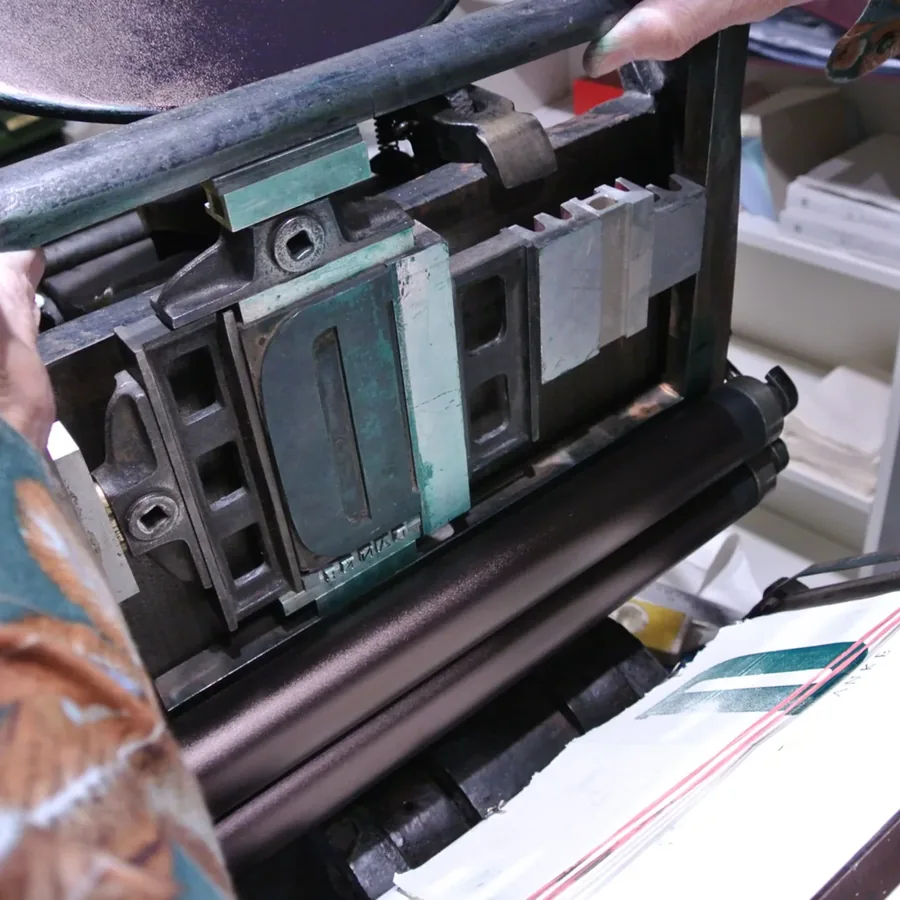
Wood type and individual embossing characters are easily confused, and they are two different things. Wood type belongs to our letterpress holdings and is inked and printed onto the paper. Embossing characters belong to embossing, they are pressed into the material with pressure and heat and are composed into names and initials. The glossary page on embossing dies has more on this.
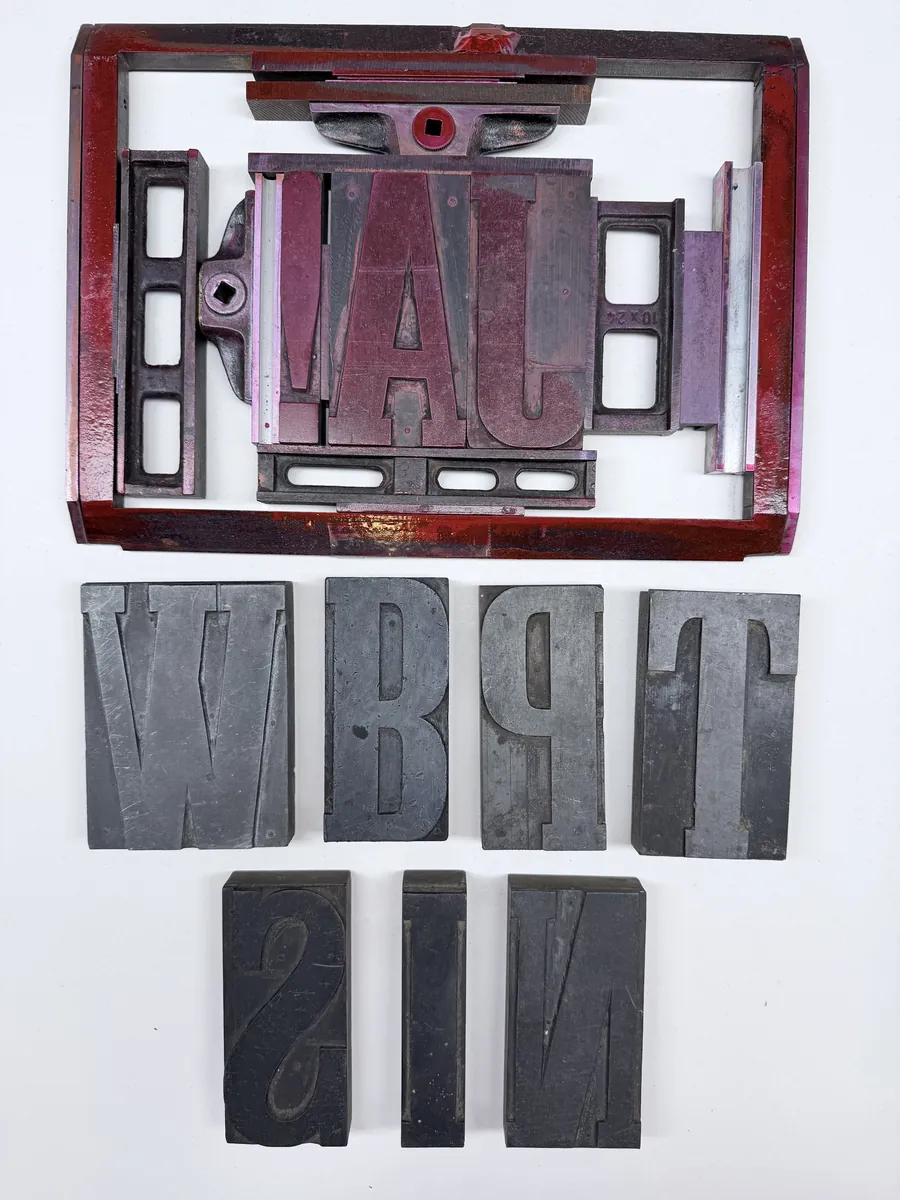
For me these old holdings are more than historical tools. They can genuinely still be put to work today.
Letterpress shows especially clearly how directly traditional printing technique and present day design can come together.
Hand tools and small aids
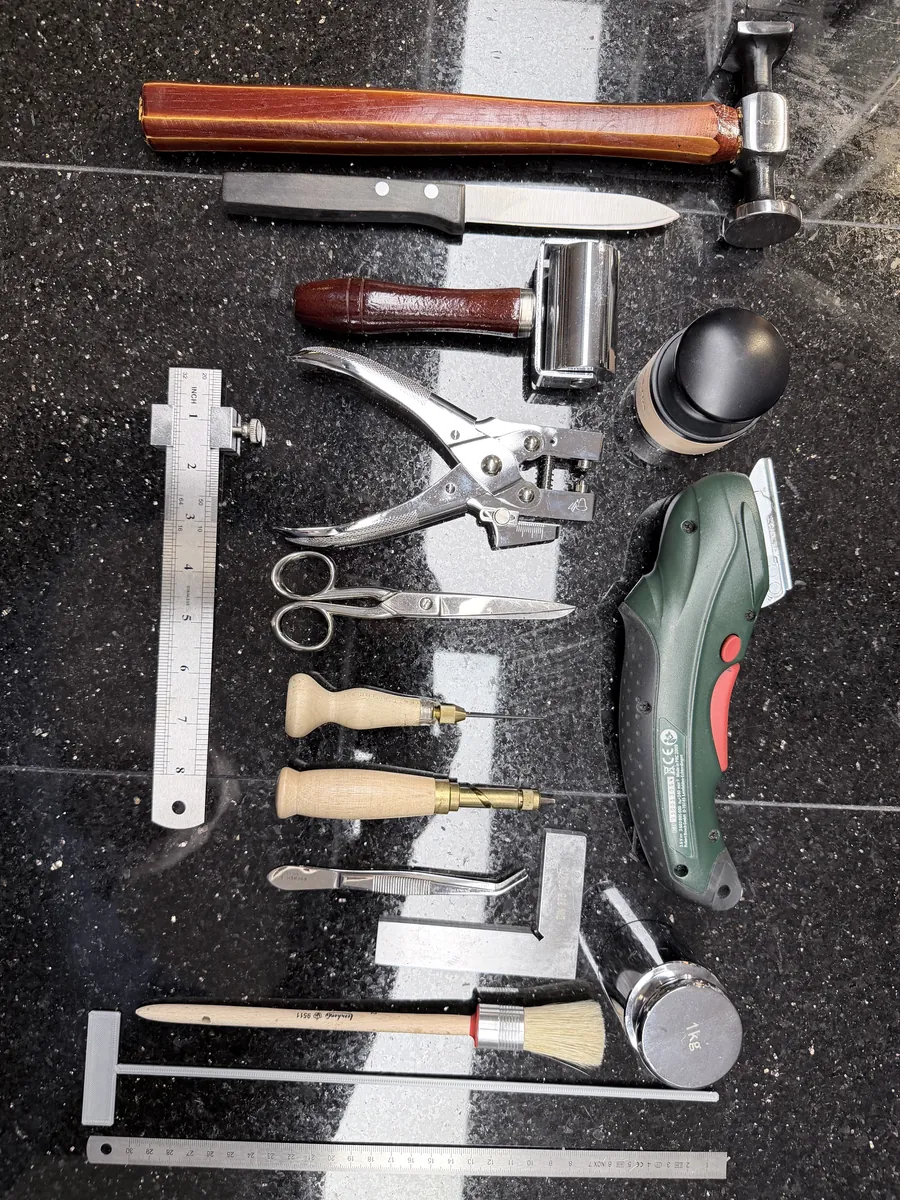
Alongside the larger machines, a great many smaller tools belong to the working day.
They include:
- a cutter
- a scalpel
- scissors
- a metal ruler
- a set square
- spacers
- a glue brush
- an awl
- a hammer
- tweezers
- magnets for weighting material down
The bone folder is another of the classic tools of our work. It is covered in more detail in the glossary entry on scoring and folding.
Some tools look unremarkable and are indispensable for precise work. A set square gives an exact alignment, spacers help with even positioning, and magnets can weight material down or hold it in place during a step.
Machines from my parents' workshop
A particular part of our workshop equipment still comes from my parents' business.
It includes:
- the Baier embossing press
- the old screw press
- the Bacher rotary trimmer
- the eyelet press
- the paper drill
- the corner rounder
- lead type
- printing plates
- wood type
I work with them because they still do their job reliably, and not because they are old.
Alongside them stand newer machines such as the Schmedt embossing press or the Opus machine. Our workshop is therefore a working set of equipment from several generations rather than a historical collection, and each piece is used according to the job.
For me that mixture is simply natural. I learned many craft processes in my parents' business and later added machines and working methods of my own.
Why does a machine not replace hand work?
In much of our work it is the person who decides the result.
An embossing press can apply pressure, and it does not decide the right position, temperature or combination of materials.
A cutting machine can cut paper precisely, and the format and the lay have to be determined beforehand.
A book press produces pressure, and the book has to be built and laid in correctly first.
In screen printing, the squeegee does not travel across the screen in the right way by itself.
Machines and tools are therefore part of the craft. They make certain steps possible, and experience, preparation and control remain decisive.
Machines & Tools at TRIXI GRONAU
Our workshop has grown over many years.
Some machines were already part of my parents' business. Others I added later, as products, materials and ways of working changed.
Traditional binding tools and old presses now stand next to more modern machines for embossing, case making and screen printing.
What connects them is their purpose. They help me work materials precisely and realise pieces the way I designed them.
For me, machines are not the opposite of hand work. They are part of it.
Questions about machines & tools
Are all the machines at TRIXI GRONAU modern?
No. Some of our machines come from my parents' business and are still in use today. Alongside them we also work with machines acquired later.
Which embossing presses do you use?
We work with a Baier embossing press and a Schmedt embossing press, also known as the Schmedt Prägnant. The Baier has a foil feed and suits repeated impressions particularly well. On the Schmedt, the piece sits directly in front of me while I work.
Is a book case made entirely by machine?
No. The case is built by hand. The Opus machine supports the work by positioning the parts, trimming the corners and turning in and pressing down the covering material.
Which materials can the electric Ideal stack cutter handle?
We use our electric Ideal stack cutter for paper, card and binder's board.
What is the old eyelet press used for today?
My parents once used it for printed luggage tags. Today I use it for gift packaging: the closure is fitted with an eyelet and gift ribbon is threaded through.
Is the old lead type still in use?
Yes. Our letterpress holdings hold lead type and printing plates from my parents' time as well as wood type. These tools can still be used for printing work.
More from the glossary