TRIXI GRONAU Manufactory · Knowledge
Bookbinding
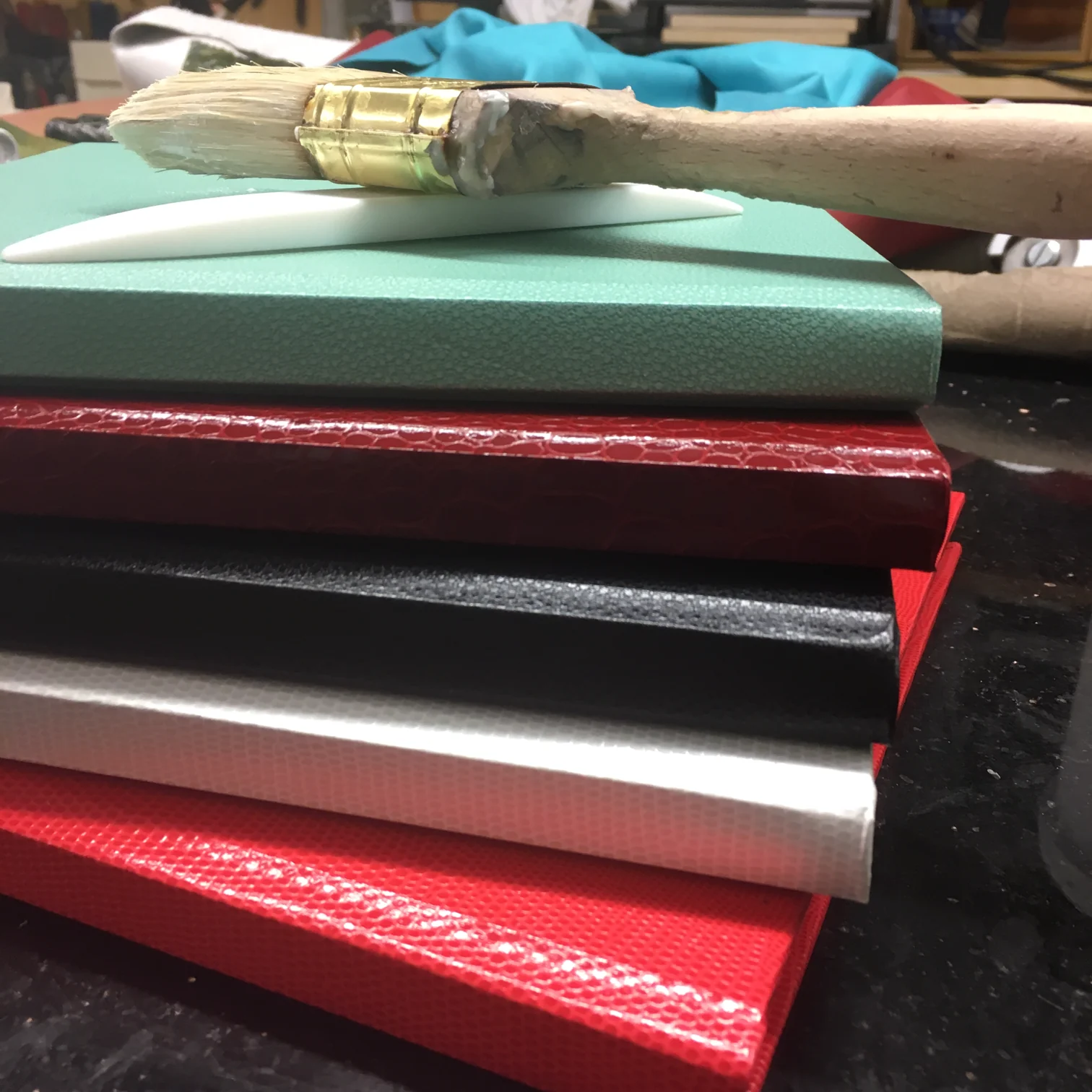
A craft that is still part of my work
For me, bookbinding is not something that belongs to the past.
It is still part of our atelier and of my work today.
I grew up with this craft.
My mother was a bookbinder, and to me she was the best bookbinder I ever knew.
She worked so meticulously that even the Delle bookbindery would sometimes ask her for help.
She taught me bookbinding from the ground up.
My mother and I worked together until she died.
On larger commissions the whole family would sometimes lend a hand.
So bookbinding means more to me than a technique.
It is a piece of family history that I carry on today.
What we make in our atelier
We still make notebooks, calendars, ring binders and special books, among other things.
I have a soft spot for formats you cannot find everywhere.
Alongside classic A5 notebooks, we work with sizes such as 22 × 22 cm or 30 × 19 cm.
Our calendars come in sizes such as 24 × 26 cm.
I choose these proportions deliberately.
Nobody else has them in quite this form. I like things that are a little out of the ordinary.
Our ring binders belong in that category too.
They are covered in Skivertex, which gives them a very different presence on a shelf from an ordinary office binder.
A binder should still look good when it is visible on a shelf.
The book block
For many of our notebooks we buy high quality book blocks in Italy.
That makes sense when the format and the paper already suit our design.
When a customer wants a special format or a version of their own, we make the book block ourselves.
Then we decide on the paper, the format and the structure to suit the commission.
The paper type and paper weight matter a great deal here, because they shape how the finished book block behaves and how it feels.
That freedom matters to me:
we do not always have to bow to an existing standard size.
Small books in special formats
Our small books measuring 12 × 8 cm are a good example.
Inside we use white paper with a very fine, light grey grid.
We perfect bind the book block ourselves and then case it in Skivertex.
The result is a small notebook that feels substantial despite its size.
We have made books like these for the magazine GALA.
For that commission the covering material was red and carried the GALA logo.
What I enjoy about commissions like that is the way material, colour, format and brand come together.
From the first cut to the finished book
Making a book involves many steps that build on one another.
We cut the board on the electric stack cutter by Ideal.
After that the handwork begins.
The covering material is cut to size, mounted on the board and turned in neatly.
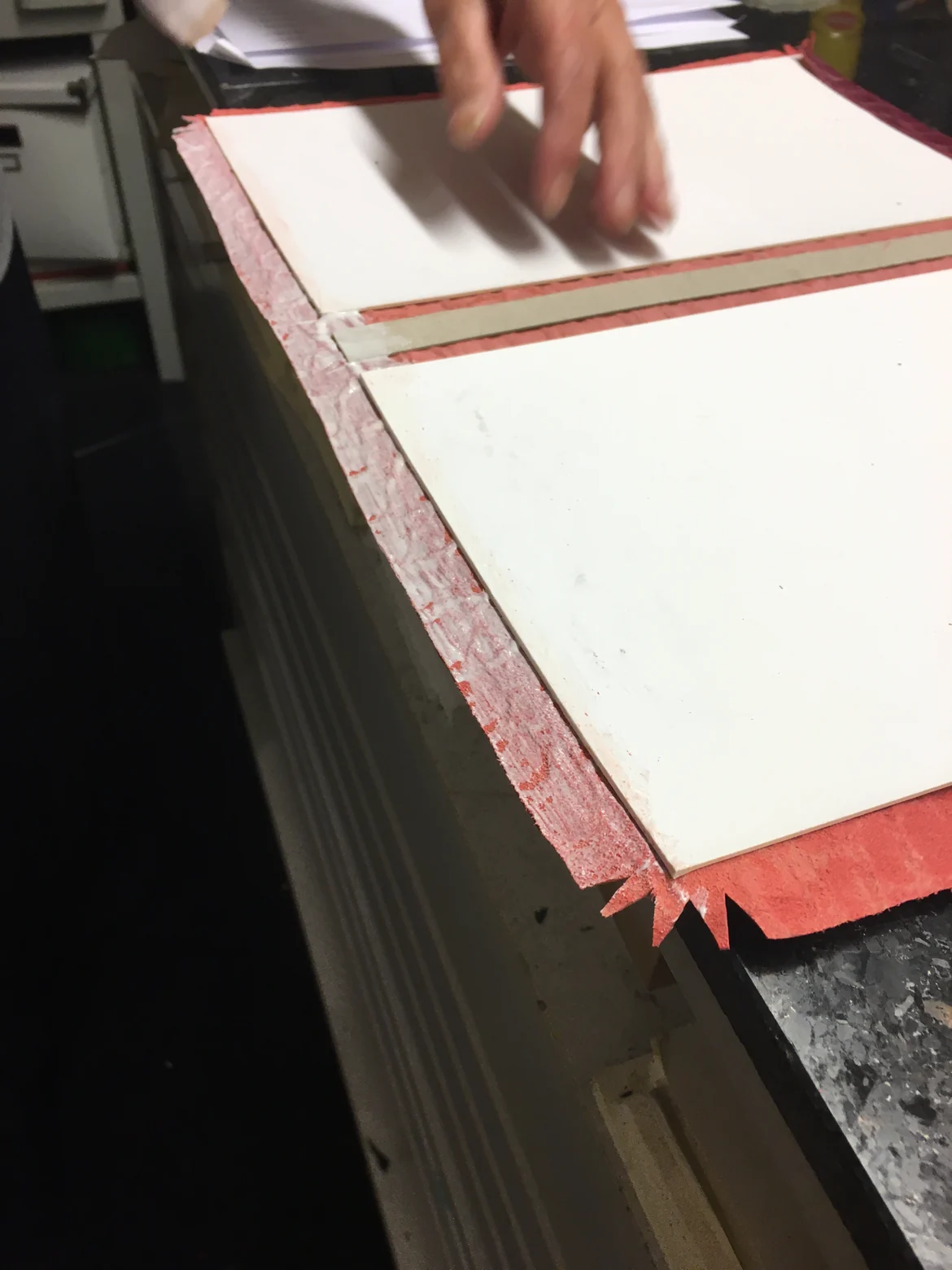
Gluing the book block and casing it in are done by hand as well.
Then it goes into the press.
Depending on the product, further steps such as creasing or punching follow.
For me the quality of a book is never decided by one single step.
Every step has to be right for the cover to come out clean.
What we still do by hand
Covering and casing in are the moments where handwork counts most.
The glue has to go on evenly.
The covering material must not bubble or ripple.
The corners have to be turned in cleanly.
And when the book block is cased in, it has to sit straight in the cover.
You can have a beautiful covering and a good book block.
If the two are joined crookedly, the whole book is poorly made.
Getting the grain direction right
The grain direction of the paper matters in bookbinding too.
Paper behaves differently along the grain than across it.
With the grain running the wrong way, pages or covers can warp later on or sit under needless tension.
So this knowledge is simply part of the work for me.
It is one of those details you may not consciously notice in the finished piece, though you can feel the difference.
How I recognise good binding
Above all, a good cover has to be even.
I look at the corners, the spine, the grain direction, a smooth surface free of ripples and bubbles, and a clean application of glue.
The book block has to sit straight in the cover.
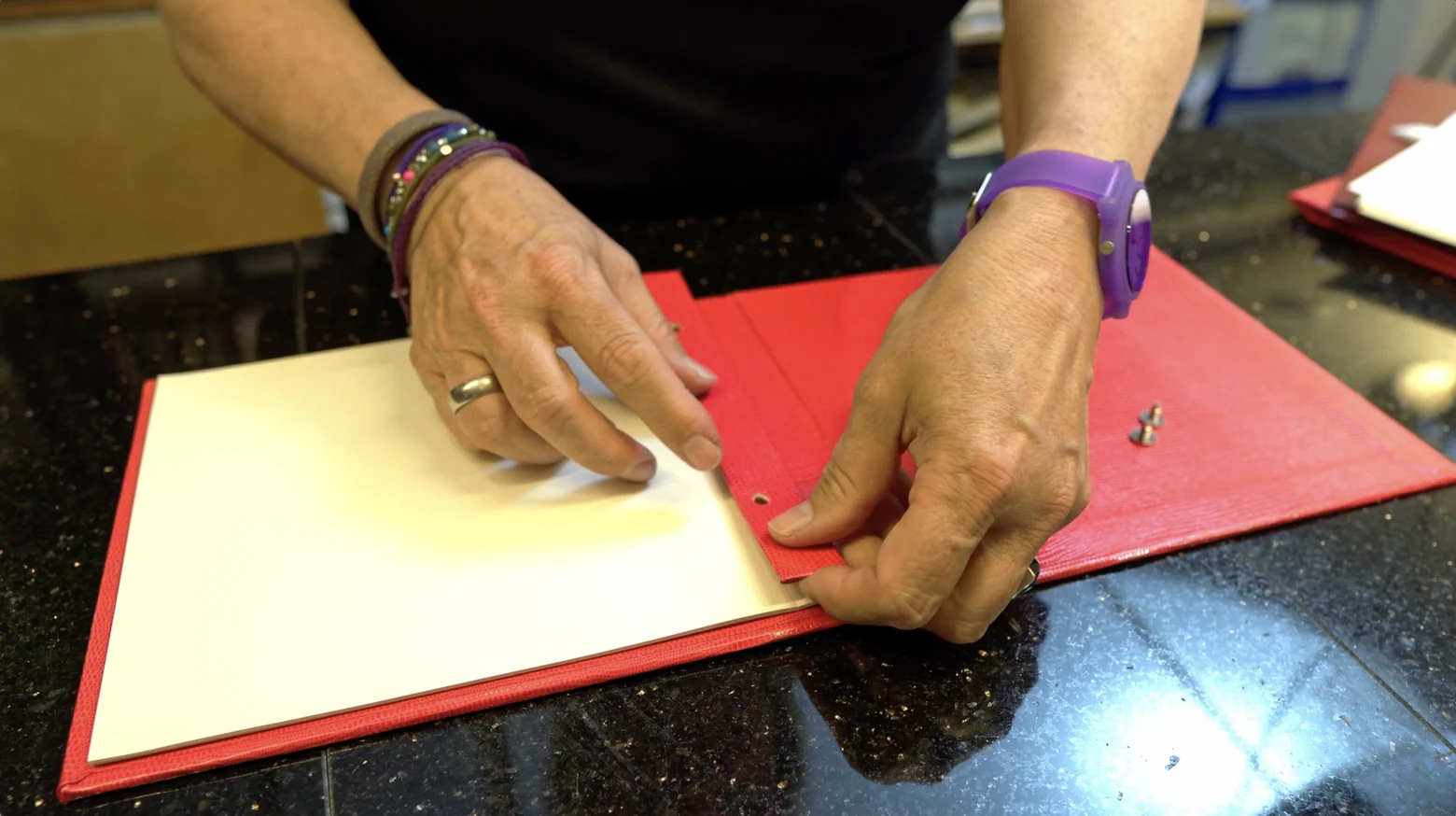
Nothing about a finished book should look accidental.
With pared back designs, small mistakes show immediately.
The simpler a design looks, the more precise the work has to be.
Common mistakes
One frequent mistake is using too much glue.
More adhesive does not automatically make a better bond.
It can make the material ripple, or squeeze out where it was never meant to show.
Badly turned corners catch the eye straight away as well.
And once the book block has gone in crooked, there is almost no hiding it in the finished book.
That is why it pays to work carefully at every stage.
Machines support the handwork
We work with a range of machines and tools in our bindery.
Among them are the electric Ideal stack cutter, a standing press and a leather paring machine.
We also have a swing arm cutting press.
You do not need a swing arm press to make a book.
It comes in for other jobs, where materials or shapes have to be cut out.
The machines take certain steps off our hands.
What they cannot replace is the feel for whether a cover sits properly and a book has been properly made.
From Hamburg to Milan, London, Korea and Dubai
Our bookbinding and leather pieces were never meant for our own concept store alone.
I have shown our collections at major trade fairs, among them Paperworld, Ambiente and Tendence in Frankfurt and Premium in Berlin.
We exhibited in Dubai as well and had our own showroom there for a time.
Through wholesale we produced calendars for the concept store Dici Como Corso in Milan.
Our notebooks were sold to customers in Korea and to Bluebird in London.
Commissions like that meant a great deal to me.
A piece made in our workshop starts with entirely traditional steps:
choosing the material, cutting the board, covering, turning in, gluing, casing in the book block and pressing.
And at the end of it, that book might be sitting in Milan, London, Korea or Dubai.
That is something not everyone has done.
Tradition and the present day
I learned the fundamentals of bookbinding from my mother.
Her precision has stayed with me.
That does not mean doing everything exactly the way it was once done.
I combine the craft fundamentals with unusual formats, modern covering materials, hot foil stamping, blind embossing and designs of our own.
Sometimes we use an Italian book block.
Sometimes we make the book block ourselves.
Sometimes a classic format is the right answer.
And sometimes it has to be 22 × 22 cm, because that is the format the design calls for.
Bookbinding is design to me
For me bookbinding does not end when the book block meets the cover.
Paper, format, covering material, colour, embossing and finishing all belong together.
A good book should feel right in the hand, open well and be cleanly made.
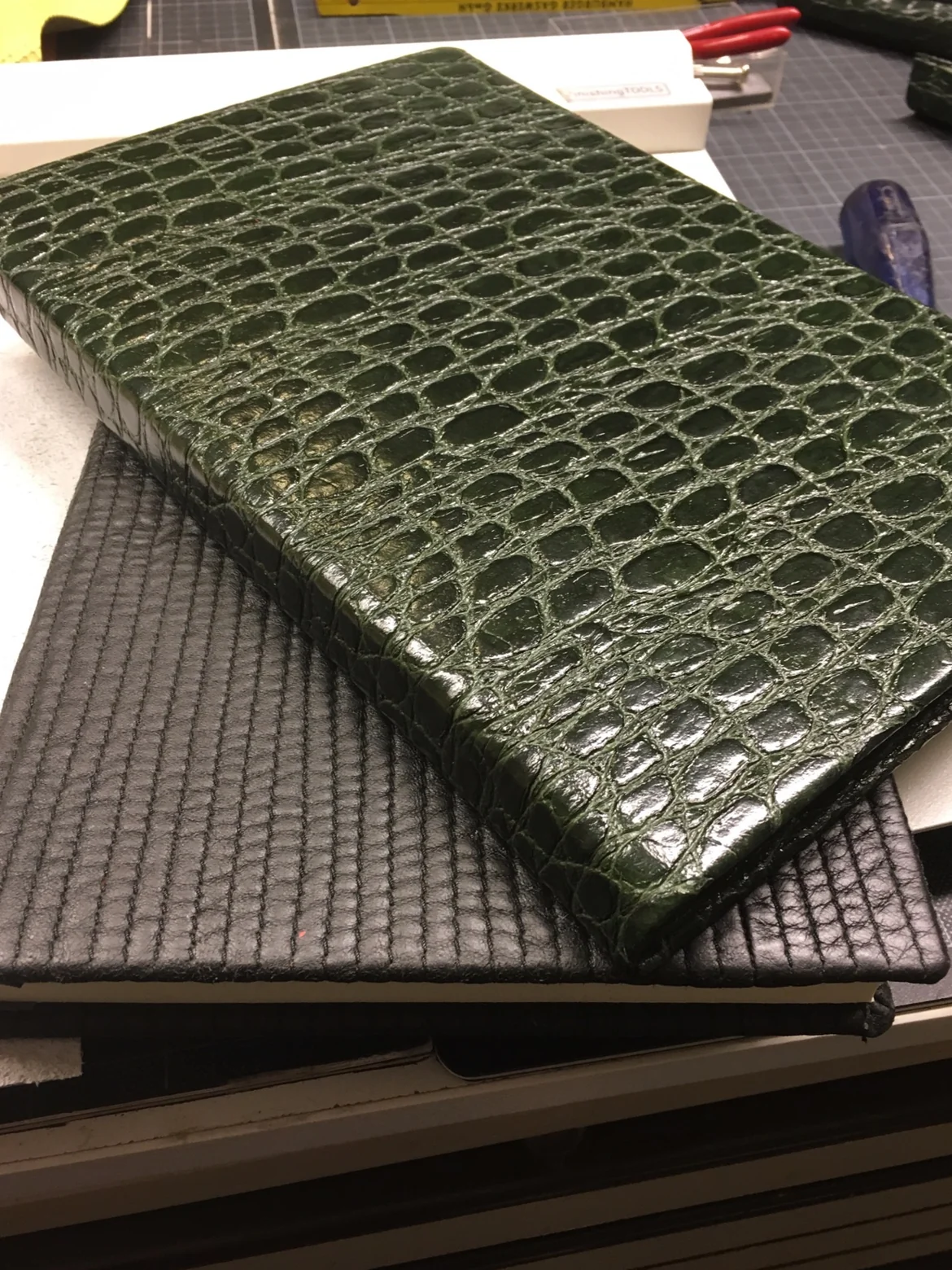
And it can have character.
My mother taught me the craft from the ground up. What I create from it continues to evolve.