TRIXI GRONAU Manufactory · Knowledge
Creasing and Folding
How heavy board gets a clean edge
On a finished folded card the fold looks like the most natural thing in the world.
Whether that edge turns out clean is decided long before.
Heavy paper and board cannot simply be bent anywhere. If the material is folded without preparation, the surface can crack, the board can split and on printed areas the ink can even flake off.
That is why we crease heavier materials before folding them.
In our manufactory this step belongs to our greeting cards and to presentation folders in heavy board, among other things.
It is one of those jobs you hardly notice on the finished product.
When it has not been done properly, you see it straight away.
What does creasing mean?
Creasing is a mechanical way of preparing a later fold.
The material is not cut through.
At the point where the fold will run, a channel is pressed into the paper or board.
The material can then give way along that line in a controlled manner.
With heavier papers and boards this matters a great deal.
Without a crease the surface can crack during folding. On printed board the ink can burst open or flake along the folded edge.
The crease absorbs part of that tension and allows a clean, straight folded edge.
From the hand operated machine to the electric creaser
My parents still worked with the classic hand and treadle operated creasing and perforating machines, of the kind built by E. Bickel for example.
So I know this way of working from my childhood and from my parents bookbindery.
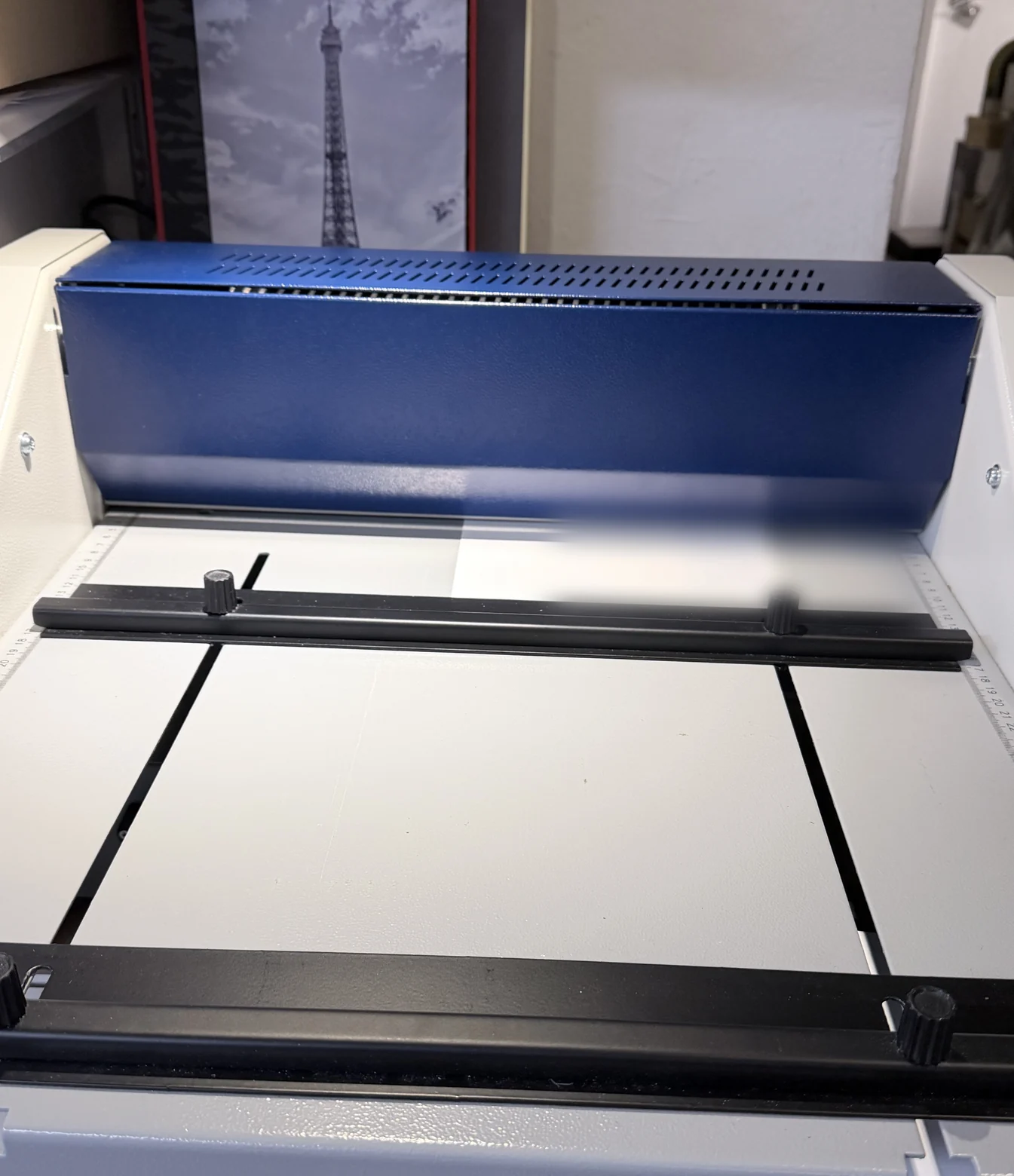
Today I work with an electric creasing machine.
The principle has stayed the same.
The sheet is laid in and aligned exactly against a stop.
The line has to sit precisely where the fold will run later.
A tool presses the material into a matching channel and prepares the folded edge that way.
The machine makes the job easier.
It still does not take the accuracy of laying on off your hands.
And heaven help you if the creases were out of line
I often helped my mother with creasing.
That taught me very early how important it is to lay every sheet on the same way.
Every sheet had to sit in exactly the same position.
My mother then knocked up the finished creased sheets neatly.
And heaven help us if the creases did not line up exactly.
She spotted it immediately.
Experiences like that stay with you.
A job can look very simple at first sight.
Yet the smallest deviation while laying on is enough for the later folded edge to end up in the wrong place.
Grain direction is part of it
The grain direction of the paper plays an important role in creasing and folding too.
During papermaking the fibres line up mostly in one direction.
If a heavier paper is folded against that fibre direction, the material comes under greater tension.
The surface can crack or split.
That is why I take grain direction into account from the start.
A crease can prepare heavy board for folding.
What it cannot do is undo an unsuitable choice of material or grain direction.
For a clean edge, material, grain direction, crease and fold all have to work together.
What we crease
All of our greeting cards are creased.
With heavier card stock this is necessary so the card opens and closes cleanly and the surface does not break along the edge.
A4 presentation folders in thick board are creased as well.
On work like that the position has to be exactly right.
The crease has to sit where the design and the construction of the folder call for it.
The heavier and stiffer the material, the more the preparation of the later fold matters.
Folding follows creasing
Creasing and folding are two separate steps.
The crease prepares heavier board for the fold.
In folding, the material is then actually laid over along the intended line.
Small runs, individual pieces and bookbinding work can be folded by hand.
For large runs there are folding machines.
I grew up with both.
Folding by hand with the bone folder
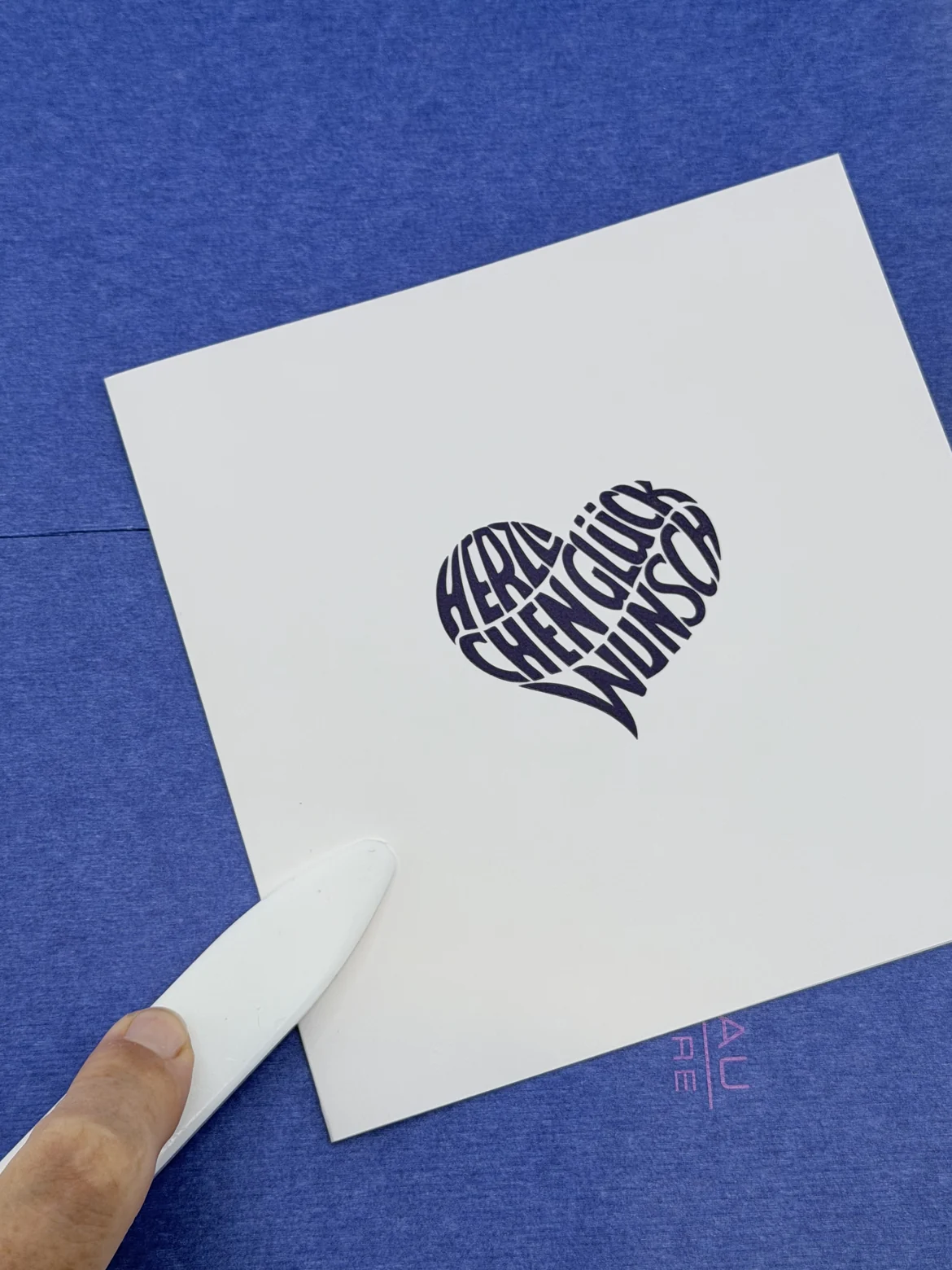
When folding by hand, the bone folder is one of the classic tools of bookbinding.
It is a narrow, smooth tool with a rounded shape.
It lets you work out a folded edge cleanly and then rub it down firmly.
Edges, glued surfaces and corners can also be pressed and formed with it in a controlled way.
Bone folders used to be made from bone.
My mother had one of those.
And she did not want any other.
She was very particular about it.
I like working with a bone folder made of Teflon myself.
With delicate materials that is pleasant, because it treats the surface gently and is less likely to leave marks.
My mother was unbeatably fast at folding
My mother was by far the fastest person at folding I have ever watched.
She could even fold several sheets at once as a section, by hand.
And she was more than fast.
The work was clean.
There was no rush about it.
It was routine.
Every movement was in the right place.
When you watch someone doing work like that over many years, you understand how much experience can sit in a seemingly simple movement.
The folding machine for large runs
For large runs we had a folding machine about three metres long.
It could make several folds in one pass.
A machine like that pays off above all with larger quantities.
Setting it up takes time.
Stops and fold positions have to be adjusted precisely and the sheet has to run cleanly through the machine.
Once the machine is set up properly, a great many sheets can be processed very evenly.
For a small run that effort often makes no sense at all.
So both belong to the work for me:
the controlled hand work with the bone folder and the machine processing of larger quantities.
By hand or by machine
For me these are not opposites.
It depends on the job.
For a large consistent run a properly set up machine makes sense.
For individual pieces, small quantities or certain bookbinding jobs, hand work is often the more direct route.
What matters is less whether something was made by hand or by machine.
What matters is whether the result is clean.
How I recognise a good crease and fold
A crease has to be straight and sit exactly where it is intended.
Across several sheets the creases have to line up neatly.
The material must not break or fray in an uncontrolled way along the later folded edge.
On printed areas the ink should not flake along the edge.
After folding, a clear and clean edge should be the result.
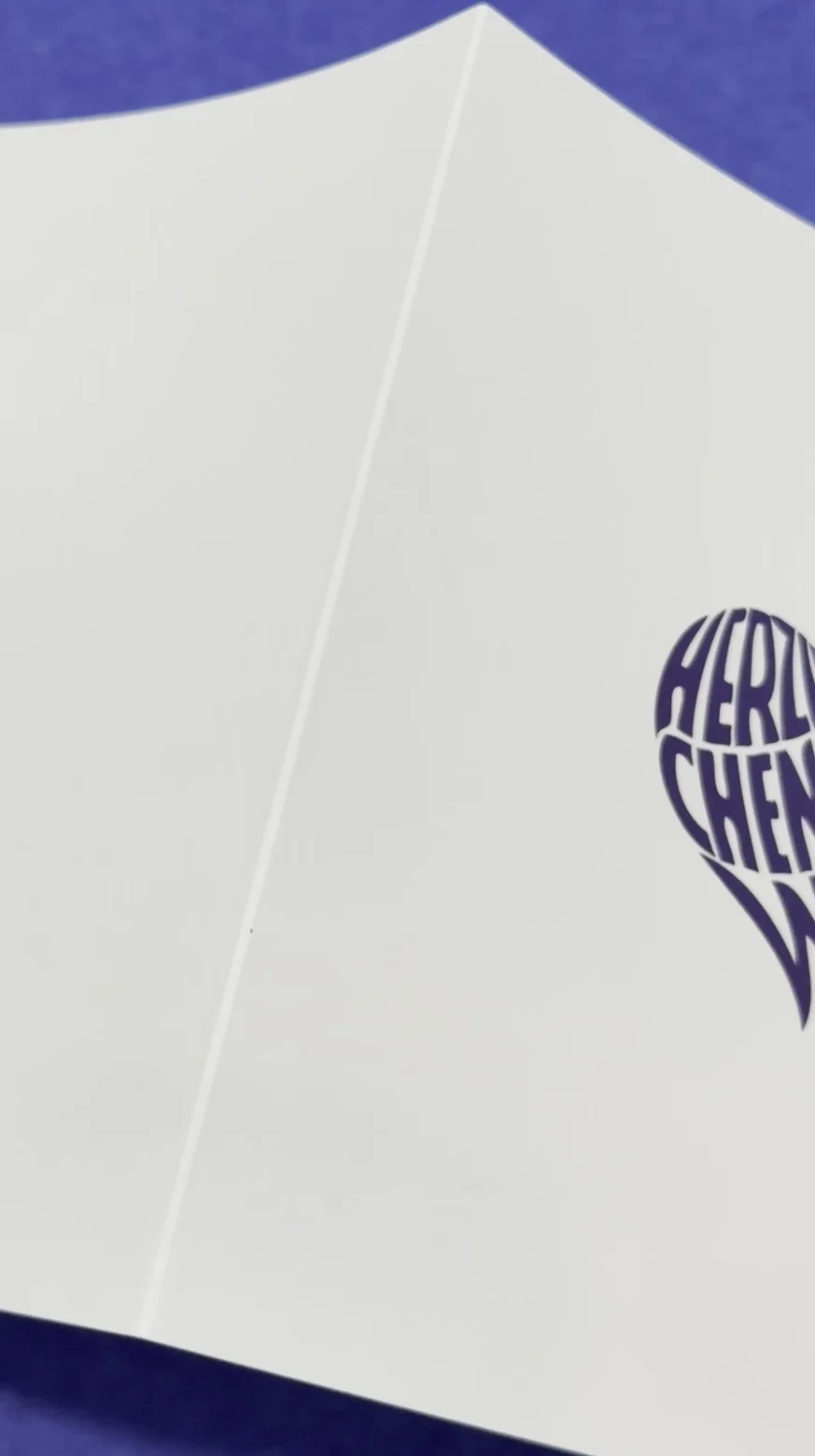
A folded card should open and close as a matter of course.
A presentation folder should lay over where the construction and the design intend it to.
When all of that is right, nobody is likely to think about how the edge came about.
Typical mistakes
A mistake can begin with laying on.
If a sheet does not sit against the machine exactly like the one before, the creases no longer line up.
A crease in the wrong place cannot be corrected later by folding especially carefully.
An unfavourable grain direction can also mean that heavy board does not react cleanly along the edge.
And when the material is too heavy for a fold and has not been prepared at all, the surface can break or printed ink can flake off.
That is why creasing is more than a minor addition.
It is part of clean finishing.
For me creasing and folding mean precision
Creasing and folding are among the steps that hardly stand out on the finished product.
A clean folded edge is not meant to look spectacular.
It is simply meant to be right.
Which is exactly why you notice immediately when it is not.
Much of what I watch for automatically today I learned from my mother.
Always the same lay.
Knock up neatly.
Look closely.
And heaven help you if the creases were out of line.